
What is a condensing boiler?
-1147x627.jpg "Hajster-4")
A condensing boiler is a type of gas boiler that utilizes heat from the steam generated during fuel combustion to supplement water heating through energy recovery.
Condensing boilers are considered to be a more efficient heating method than traditional gas boilers, as the second ones heat water to the required temperature and simply emit the combustion products outside, not using the full potential of the energy produced. However, if we compare them to heat pumps, the latter are more efficient and can provide up to 80% energy savings compared to 10% for condensing boilers. It should be understood that the efficiency of each device can vary depending on various factors, such as climatic conditions, building insulation, and the type of heating system.
Condensing Boiler: Working Principle
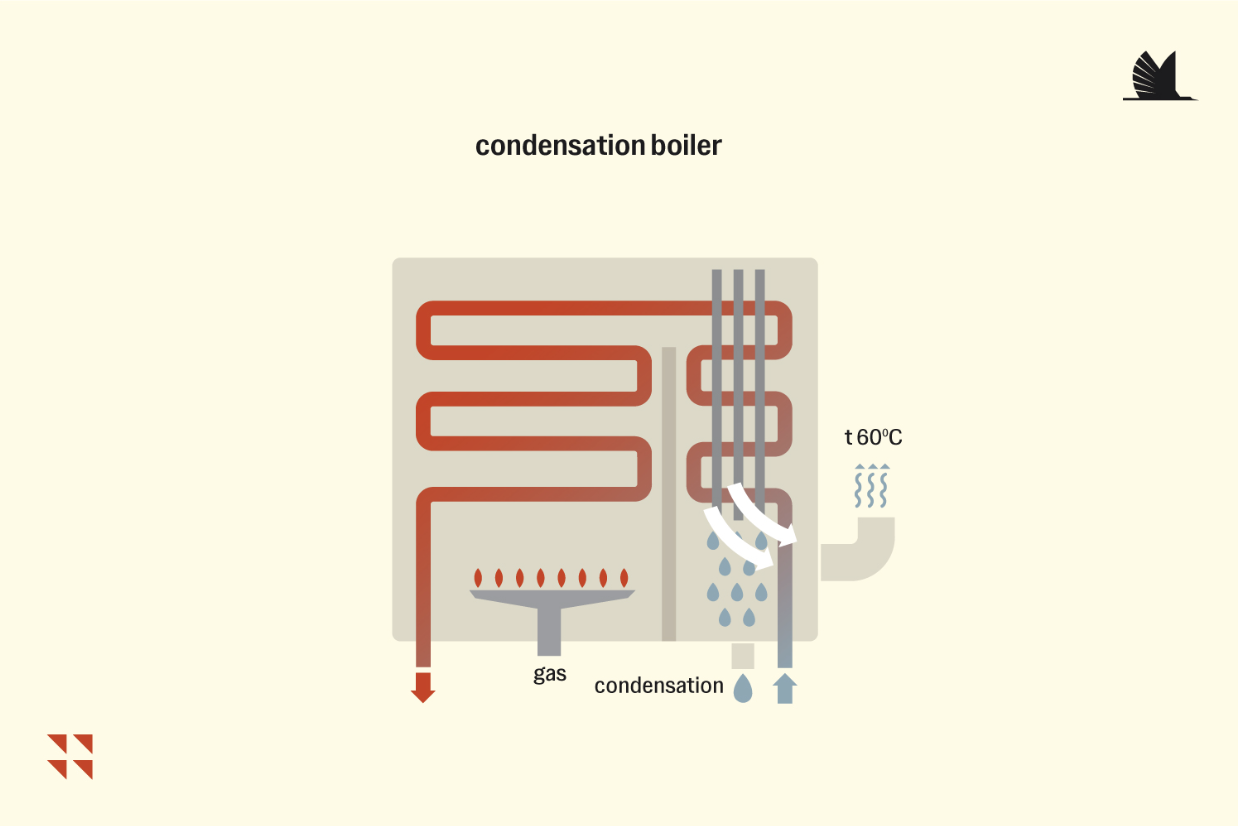
Let's take a look at how a condensing gas boiler works by comparing it to a heat pump. The basic principle of operation of a gas condensing boiler can be described as follows:
First stage: fuel combustion.
The boiler burns natural gas or other fuel in a special combustion chamber. During this process, heat is generated, respectively, by combustion products such as water vapor (hydrogen and oxygen), carbon dioxide, and other components.
Second stage: heat extraction.
The heat generated during combustion is transferred to the heat carrier - water circulating in the heating system. The heat warms the water, which is fed to radiators, convectors or underfloor heating, and in turn heats the room.
The third stage is steam condensation.
In condensing boilers, the main emphasis is placed on utilizing the energy of water vapor, which is generated during combustion. The steam remains in the flue gas and then condenses on the cold surfaces of the stainless steel heat exchanger, turning into water (condensate). This process releases additional heat, which in a conventional gas boiler would simply be released to the outside and lose its energy potential.
Comparison of the principle of operation of a condensing boiler and a heat pump
A heat pump uses energy from the environment (e.g. air, soil or water) to transfer heat from one place to another. It works on the principle of compression/expansion of the cooling medium, rather than on the burning of fuel, as in a condensing boiler. You can learn more about the principle of operation of a heat pump in the article "Heat Pump / Part 1 - Principle of Operation and Structure".
So, the main difference between the technologies is that a condensing boiler uses the heat generated by the combustion of natural gas or other fuels, and its capabilities are usually only enough to heat objects. The heat pump, in turn, is used for both heating and cooling, and the principle of operation is based on one of the fundamental principles of thermodynamics - the Carnot cycle - on the transfer of temperature by the working fluid (refrigerant) without burning fuel, which makes the device eco-friendly and completely safe for the user.
What are the types of condensing boilers?
Condensing boilers can be classified by several basic parameters, such as fuel, technology, and application. Each type may have its own variations and features, depending on the manufacturer, model, and technical specifications.
Here are some of the types of condensing boilers:
By fuel:
- Gas condensing boilers: use natural gas or liquefied petroleum gas (propane, butane) as fuel.
- Oil condensing boilers: use oil as fuel for combustion and heat generation.
- Solid fuel (pellet).
By technology:
- Single-circuit: provide only heating or only hot water supply.
- Double-circuit: a double-circuit condensing gas boiler provides both heating and hot water supply.
By application:
- For residential buildings: used for heating and supplying hot water in residential buildings.
- For commercial and industrial facilities: used for larger facilities, such as hotels, restaurants, factories, etc.
The choice of the optimal type of condensing boiler requires taking into account your individual wishes and the features of the building, such as its size and direction of use. It is important to consider the efficiency, power, and capabilities of the boiler in the context of your heating task to ensure the best result. However, if the goals of your project include not only heating but also cooling the space and providing hot water, then a heat pump will be the best solution - it will solve all climate needs at the same time.

Condensing boilers: Advantages and disadvantages
To better understand which boiler to choose for an apartment or house, it is necessary to analyze the pros and cons of a condensing boiler.
Advantages:
- Increased comfort: they offer convenient operation and maintenance. Additionally, condensing boilers are more compact than traditional boilers and can increase the amount of space available in a room.
- Additionally: they have the ability to work with low water temperature, which can be useful for owners of houses with central heating.
Disadvantages:
- Energy savings: condensing boilers use energy more efficiently than old traditional boiler technology, but perform much more poorly than modern heat pumps. The COP efficiency, which determines how much heat is obtained per unit of incoming energy, is 2 times higher for heat pumps than for condensing boilers (3-4 for heat pumps versus 0.9 to 1.2 for condensing boilers).
- Cost: The average efficiency of a condensing boiler results in average heating bills, which does not justify the reasons for installing the device either for a heating system reconstruction or for a new project, as there are already modern alternatives on the market, such as heat pumps, where this difference in performance will be much more noticeable.
- Condensate discharge: a siphon, a special device for removing condensed water from flue gases, is required.
- Correct engineering: if the condensing boiler doesn't operate at the correct temperature of the heat carrier, its efficiency can be low, so you need to carefully approach the engineering process.
- Reconstruction: since the flue gas temperature of a condensing boiler is low, the chimney must be adapted to these requirements during reconstruction, protecting it from destruction.
- Eco-friendliness: condensing boilers are less environmentally friendly than heat pumps, which don't emit any emissions at all.
- Fire danger: gas boilers are dangerous due to the possibility of gas leakage, which can create a dangerous situation, so careful attention should be paid to proper installation, inspections as well as maintenance.
In summary, after analyzing all these factors, we can conclude that choosing a condensing boiler is not the best solution in 2023, as more economical and efficient heating solutions, such as heat pumps, have long been on the market. Thus, compared to a traditional gas boiler, the owner of a condensing boiler receives a number of advantages: greater energy and cost savings. However, new market trends should be taken as a benchmark. If we compare gas boilers with heat pumps, the second ones will have advantages in safety, because heat pump technology is gas-free, in efficiency and savings, which is 2 times higher than boilers, and in the confident long-term reliable operation of the device.
Before making a final decision, we recommend consulting with experts who will take into account individual wishes and expectations, as each project has its own characteristics and the most optimal solutions.
If you have any additional questions, you can contact Hajster's specialists - 24/7 service support.
Hajster. Doing climate right.


-1147x627.jpg "Hajster-9")